
Research news: The hidden effort people with CP make to fit in
A new research project shows how people with CP not only live with a different body but also engage in ongoing, invisible efforts to simply be themselves. A researcher challenges notions of normality and offers new perspectives on disability.
She experienced it firsthand - at hospital treatments, physiotherapy sessions, and in conversations with family and others around her. The feeling that being born with cerebral palsy (CP) was seen as a deviation, a personal defect, that had to be fixed or hidden away to avoid being marginalized.
This perception followed Olivia Dahl throughout her childhood, and it was something she later began to question. During her sociology studies at the University of Copenhagen, she found that the experiences of people born with a disability were largely missing from research. This became the starting point for several years of research into how disability is understood and ultimately led to her recently completed PhD thesis on the subject.
Her PhD project, “From Outsider to Crip,” is supported by the Elsass Foundation and investigates how people with CP understand and manage their disability in everyday life. According to Dahl, the study shows that people with CP regularly carry out invisible work just to be themselves.
"Having CP can be quite demanding, as the body itself can present challenges. At the same time, people must navigate physical barriers in society, such as stairs or lack of accessibility. But beyond that, many people with CP put extra effort into simply being themselves. This includes not only securing the support they need, but also the considerable invisible work needed to gain social recognition," says Dahl.
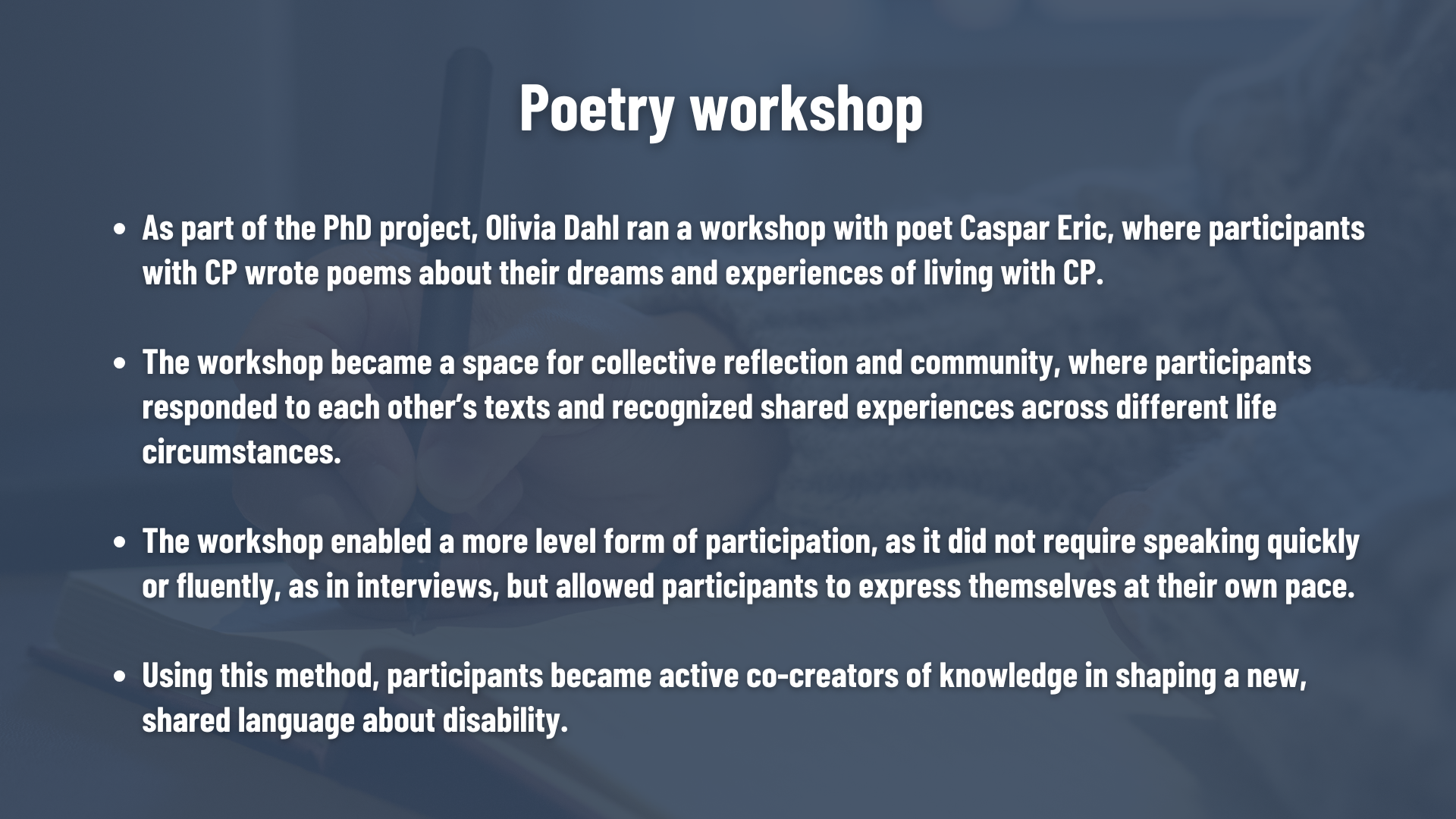
Through interviews, focus groups, and a poetry-writing workshop, Dahl has given a voice to those who are often spoken about - but rarely spoken with - in her thesis.
"I wanted to challenge the traditional way we research disability. But also the traditional medical and scientific frameworks for discussing disability," she explains.
Hide it or shout it out
Dahl highlights situations in everyday life where people with CP are constantly balancing many different roles to navigate the prejudices and social expectations they encounter.
One example is the transition from childhood to adulthood, where many people with CP begin an education and may need to access help from the municipality.
"People with CP are constantly managing others’ perceptions of them," explains Dahl. "They have to make their disability visible to get help from the municipality, yet hide it in a new educational setting to fit in."
She describes how constantly switching between “shouting” and “hiding” a disability can lead to a lifelong navigation of an ‘invisible layer’ of social and emotional labour - one that goes beyond physical challenges and touches on the right to be themselves.
"There is a paradox in that people with a disability must continually work to make it less visible, while also learning to be themselves. It’s a paradox that many people with CP face every day," says Dahl.
Everyday strategies
Through her interviews, Dahl learned about the different ways people with CP manage everyday life.
One person, for example, used humour, referring to “CP” as “Charming People” when asked what CP stands for. Another person, using an electric wheelchair, would have their assistant step outside the shop when speaking to the cashier to avoid being spoken over.
"These may seem like small strategies, but for many of those I spoke with, they are crucial for creating a new narrative. These small actions matter a great deal," emphasizes Dahl. "They are acts of resistance that insist on the right to exist as a human being."
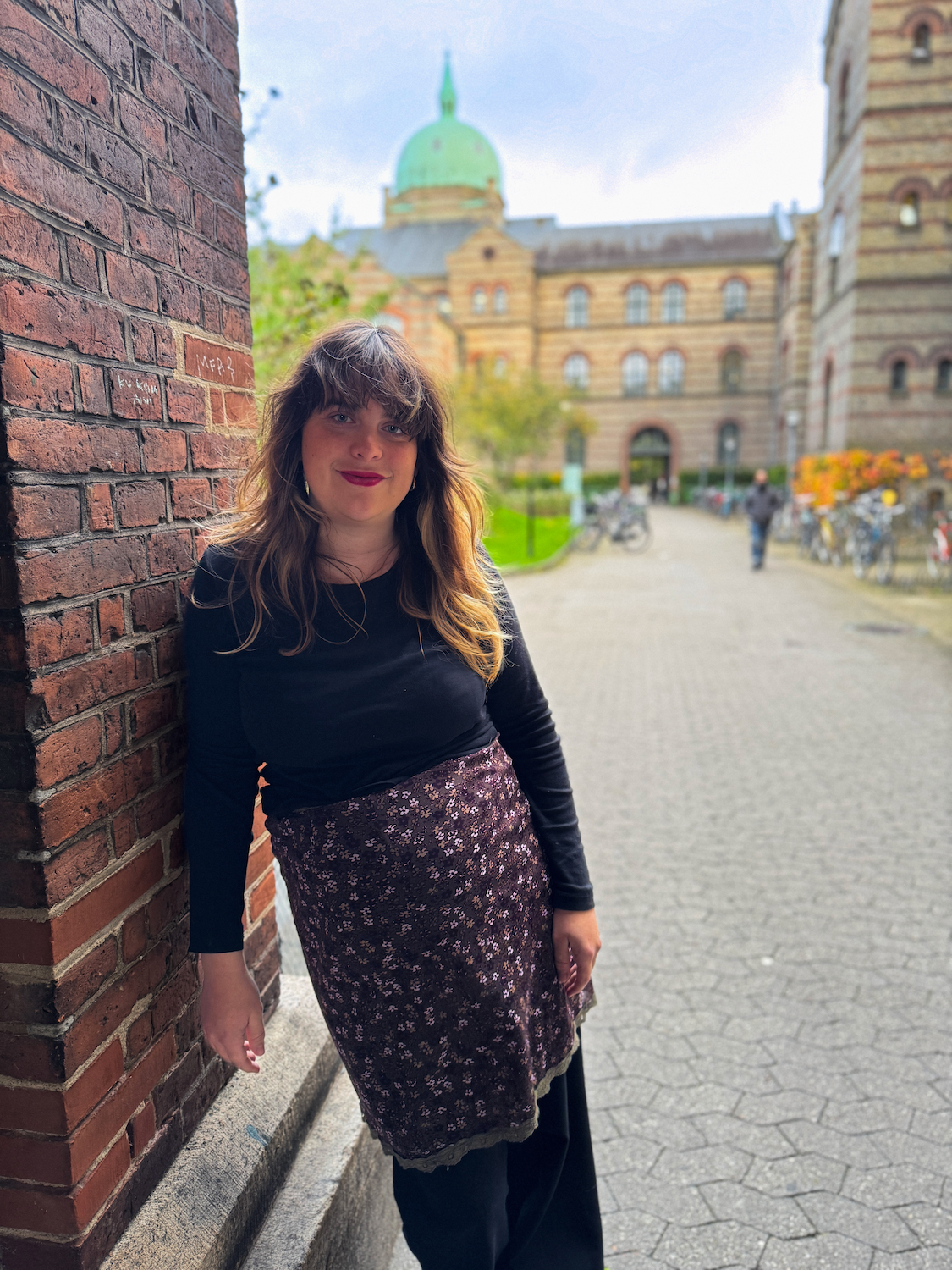
Olivia Dahl is currently expecting her first child. After maternity leave, she will continue with a postdoc project on the transition from youth to adulthood with CP. The project is funded by the Elsass Foundation, which seeks to support important research on quality of life for people with CP. PHOTO: Elsass Foundation
A collective task
Dahl points out that as long as resistance is left to individuals and remains invisible, it becomes extremely demanding. She calls for collective efforts to create spaces where having a disability is recognized as normal and still compatible with belonging to the community.
According to Dahl, this requires broader forms of organization that make room for multiple ways of being human.
"We need to challenge this very narrow concept of normality, both socially and in bureaucratic systems like municipal application processes. It could also involve campaigns or programs in schools and universities that show that everyone is welcome. People with disabilities are not the ones who need to be fixed. It is society, and the discourses we have learned to speak from, that must change" says Dahl.
Reflection in practice
Negative perceptions of disability and the body are evident in Dahl’s interviews with people with CP.
"Several participants describe how CP - even when spoken about with kindness and good intentions - is often portrayed as something to be gotten rid of; a personal defect that should be 'repaired.' I find that this understanding has become a dominant narrative throughout society, so it shapes how we navigate in schools, in families, and even our own thinking. It is the only way we’ve learned to talk about it," explains Dahl.
She hopes her research can inspire parents, professionals, and educational institutions to speak differently about disability and reflect on their own understanding of it.
Dahl also urges professionals to recognize the hidden work that many people with disabilities constantly perform to manage daily life and to actively use that insight in practice.
"A doctor’s job is to support people’s health - that is their core professional task. But the language we use is maybe even more important: How do I talk about having a disability, how do I meet people with disabilities, and what am I equipping them with as they go into the world?" says Dahl.
She hopes the project will also spark reflection on how exclusion can occur unintentionally in contexts like education.
"How do I create empowerment for children instead of trying to standardize or normalize them? And how can I challenge the rules that define who can participate in a learning space? If a child who uses a wheelchair always ends up in the corner during PE, then the teaching may be too narrow," she says.
Dahl also notes that many parents - wanting the best for their child - often embark on a journey where the child must be trained and pushed to fit some idea of normality.
"Could that journey be shorter and less painful if we had communities and a language that recognized disability as a natural way of being human?" asks Dahl.
A new narrative on disability
The title of her thesis, “From Outsider to Crip”, reflects the everyday challenges and decisions that people with CP navigate.
She describes the experience of being an outsider as feeling excluded and different from what society considers ‘normal’. The concept of “Crip,” on the other hand, represents an identity and community that challenges society’s ideas of a ‘normal’ body.
"The Crip movement is about embracing yourself and your disability - and about challenging the structures in society that exclude disability," explains Dahl. "It’s also about creating new communities and a common language around disability."
Dahl sees signs that this is already happening in culture, research, and political contexts. She notes that the Crip movement aligns with societal trends that young people today want to support. But there is still a long way to go.
"We are far behind in Denmark when it comes to representing people with disabilities in society. But things are happening these years. Young people today are born into MeToo, Pride, and Black Lives Matter. This gives them new ways to relate to societal movements, like the Crip movement. More people are reclaiming the word and celebrating CP as a way to push back against stigma," explains Dahl, adding:
"It’s a grassroots movement - from the young people themselves. They have lacked a community and a means of discussing disability - a language I hope my PhD project can contribute to, since the Crip perspective presents new ways to talk about disability. I find that young people are ready to accept multiple ways of being human. We need to support and promote this perspective."
Read the PhD project “From Outsider to Crip - How people with Cerebral Palsy navigate and negotiate perceptions of disability, normality, and good lives in everyday life” here.