
Only one in three people with CP are employed: report highlights cognitive challenges as a barrier
New research shows that cognitive challenges in people with CP can be hard to recognise and are often a critical barrier to entering the workforce. Over time, this can lead to exhaustion and sick leave. Research calls for systematic screening and greater awareness of CP.
The final touches have just been put on a new research project from Aalborg University about employment and cerebral palsy (CP) - a project supported by the Elsass Foundation.
For the first time, a study has mapped out the barriers that people with CP face in the job market. Barriers that need attention, since the findings also show that only one in three people with CP are currently employed.
The project was carried out by Professor Thomas Bredgaard and Research Assistant Emilie Skyum-Jensen from Aalborg University, together with Senior Researcher Frederik Thuesen from VIVE. The team conducted surveys and interviews with people with CP, employers, and job centre staff.
One finding in particular surprised the researchers:
“We hadn’t realised how much impact cognitive challenges have on employment for people with CP,” says Bredgaard and continues:
“It’s hard for an employer to see what kind of support someone with cognitive difficulties needs, unlike visible motor challenges. At the same time, it can be difficult for jobseekers to talk about their challenges and, for example, say: ‘I get tired more easily’ or ‘I struggle to keep track of everything.’”
Ignorance breeds stereotypes
Senior Researcher Frederik Thuesen from VIVE led the survey and notes that many participants experience challenges that often require accommodations in the workplace:
“About 40 percent of participants experience moderate to significant cognitive challenges, such as problems with concentration or keeping an overview of tasks. In addition, two out of three participants say they struggle with fatigue.”
Research Assistant Emilie Skyum-Jensen, who interviewed both jobseekers and employers, points out that asking for support for cognitive challenges can be difficult.
“Several participants said they find it easier to talk with employers about physical accommodations, like assistive devices or being excused from physical tasks, whereas cognitive needs such as quiet surroundings, predictability, or extra breaks are harder to talk about,” says Skyum-Jensen. She adds that cognitive challenges are easily misunderstood when others cannot easily see them:

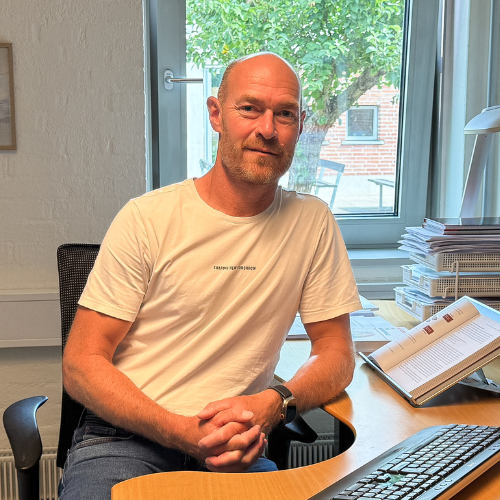
Professor Thomas Bredgaard and Research Assistant Emilie Skyum-Jensen from Aalborg University with Senior Researcher Frederik Thuesen from VIVE. Photo: Elsass Foundation
“It’s a very stigmatised area where lack of knowledge quickly turns into stereotypes and prejudice. Several participants described how others often associate cognitive challenges with low intelligence,” says Skyum-Jensen.
According to Thuesen, nearly half of those who took part in the study have encountered prejudice, which makes it even harder for people with CP to find their way in the job market:
“They constantly have to decide how much to share. At the same time, they have to explain themselves to job centres, employers, or colleagues by saying: ‘I can manage x, y, and z, but after that, I get tired,’” says Thuesen.
“Maybe I’m the problem”
Bredgaard explains that the combination of visible and invisible disabilities creates a type of “double stigmatisation” for people with CP, who are often met with assumptions about both physical weakness and low intelligence.
“These prejudices can affect a person’s self-image to the point where they internalise these prejudices and the expectations of others,” he says.
“Many end up blaming themselves for their situation, thinking, ‘Maybe I’m the problem,’ or ‘I’m not doing enough.’ We see this both among people with CP and among unemployed people more generally. Sometimes, it’s even built into the employment system, which indirectly suggests: ‘It’s really your own fault; you’re not applying for enough jobs, not being flexible enough,’ and so on.”
Burnout around 40
According to the report, job centre staff often see two typical patterns among people with CP in job centres.
The first group consists of young people transitioning from education to employment, where limited work experience and weak coordination between educational institutions, unemployment schemes, and job centres can form barriers to entering the job market.
The second group includes people with CP around the age of 45, who after years in the workforce can no longer maintain regular employment and have to take sick leave.
“We see a clear dip around age 45–50, when age can also start to have an impact. Up to that point, many have pushed themselves - ‘gritted their teeth’ - and felt they had to overperform to keep up with normal work demands. Some manage for years, but many eventually burn out, experience stress, and in some cases end up on sick leave or in supported employment,” says Bredgaard.
According to the research team, this is one of the reasons that many people with CP only gain a realistic understanding of their condition later in life:
“Several participants with CP told us they hadn’t realised they had cognitive challenges. That makes it hard for them, and for employers and job centre staff, to identify what kind of cognitive support they might need,” says Skyum-Jensen and continues:
“Some participants grew up being told that CP was purely a physical disability, so they didn’t connect difficulties like concentration or planning with their CP. All of this points to a lack of knowledge about what CP actually involves.”
“Many end up blaming themselves for their situation, thinking, ‘Maybe I’m the problem,’ or ‘I’m not doing enough.’ We see this both among people with CP and among unemployed people more generally. Sometimes, it’s even built into the employment system, which indirectly suggests: ‘It’s really your own fault; you’re not applying for enough jobs, not being flexible enough,’ and so on.”
Screening is the way forward
The research team has identified that lack of awareness is one of the major barriers to improving employment among people with CP.
“We know from previous research that a lack of knowledge about disability affects their ability to stay connected to the job market. But the lack of knowledge is particularly pronounced when it comes to CP. Few people understand what it is or what challenges it entails,” says Bredgaard.
The team therefore recommends an initial screening process that identifies a jobseeker’s strengths and potential challenges, and how these might affect the types of jobs they can perform.
According to Bredgaard, functional impairments are often only noticed if the individual reports them. This can make the problem worse if the person with CP is not aware of their own challenges.
“It’s assumed that what works for other unemployed people also works for those with CP, but we don’t know that. It’s a particular type of functional impairment, which likely requires a special kind of effort to help this group back into the job market,” says Bredgaard.
Job centre staff who took part in the project recommend using neuropsychological assessments to help increase employment, an approach that several participants found useful. However, such assessments are not currently part of standard employment support.
Bredgaard agrees that job centres should, at an early stage, determine whether individuals with CP have functional limitations that should be considered when looking for work.
“My core philosophy has always been that this shouldn’t fall on the individual,” says Bredgaard.
“Society must take responsibility for addressing it, rather than the individual. For job centres, that means introducing screenings and dedicated disability specialists. For employers, it means taking responsibility for assessing whether accommodations are needed,” explains Bredgaard.
Awareness of CP is crucial
The research team hopes their report will help draw attention to the barriers preventing people with CP from joining the workforce.
“Our hope is to spread this new knowledge about CP and employment and to raise awareness about how people with CP can best be supported in becoming part of the workforce. Some of these findings may also apply to other groups with functional impairments, so we hope the results gain broader attention,” Bredgaard explains, concluding:
“Information and education are absolutely crucial. People need to understand more about CP and what it means to live with functional impairments. We all experience some degree of functional limitations throughout life, so my hope is that we can normalise it and create a more positive narrative around functional impairments.”
Read the report here (in Danish).
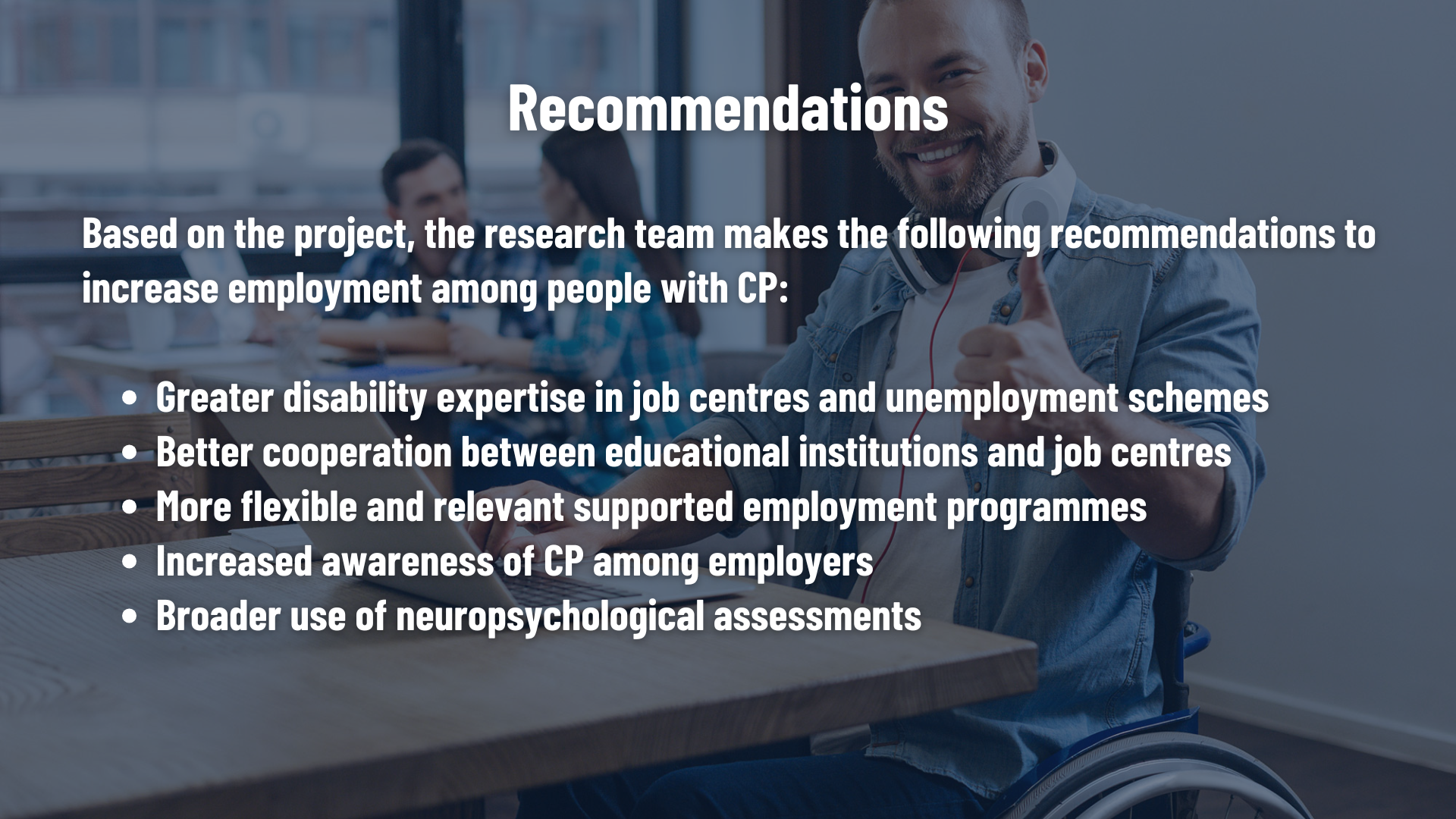
The report presents five recommendations that may help improve employment opportunities for people with CP and reduce the barriers identified in the study.

