New research: App reveals hidden fatigue patterns
A new PhD project maps fatigue in everyday life and reveals patterns that would otherwise be difficult to detect. The goal is to gain a better understanding of fatigue in adults with CP or acquired brain injury, which in the long term may lead to concrete recommendations in clinical practice.
Fatigue is a common and often overlooked challenge for people with cerebral palsy (CP). Up to half experience fatigue to a degree that can be both disabling and severely limiting to their quality of life. Yet fatigue can be difficult to describe, measure, and understand for those around them.
“It can be challenging to provide guidance about fatigue because it is so individual – and because many people struggle to put it into words,” says occupational therapist and PhD student Sun-Hee Skovgaard Christensen from the Neurorehabilitation Research and Knowledge Centre, Copenhagen University Hospital - Rigshospitalet.
She is leading a new research project that investigates fatigue in an entirely new way: through real-time tracking in an app.
“When participants register their fatigue in real time, it gives us unique insight into when and how it arises,” she explains.
In her three-year PhD project, supported by the Elsass Foundation, she is investigating whether a thorough mapping of fatigue in daily life can provide new insights - and open the door to more targeted strategies for preventing fatigue:
“The hope is that we can give people with CP a better understanding of their own fatigue patterns, and at the same time provide professionals with knowledge and new tools to support them in managing it.”
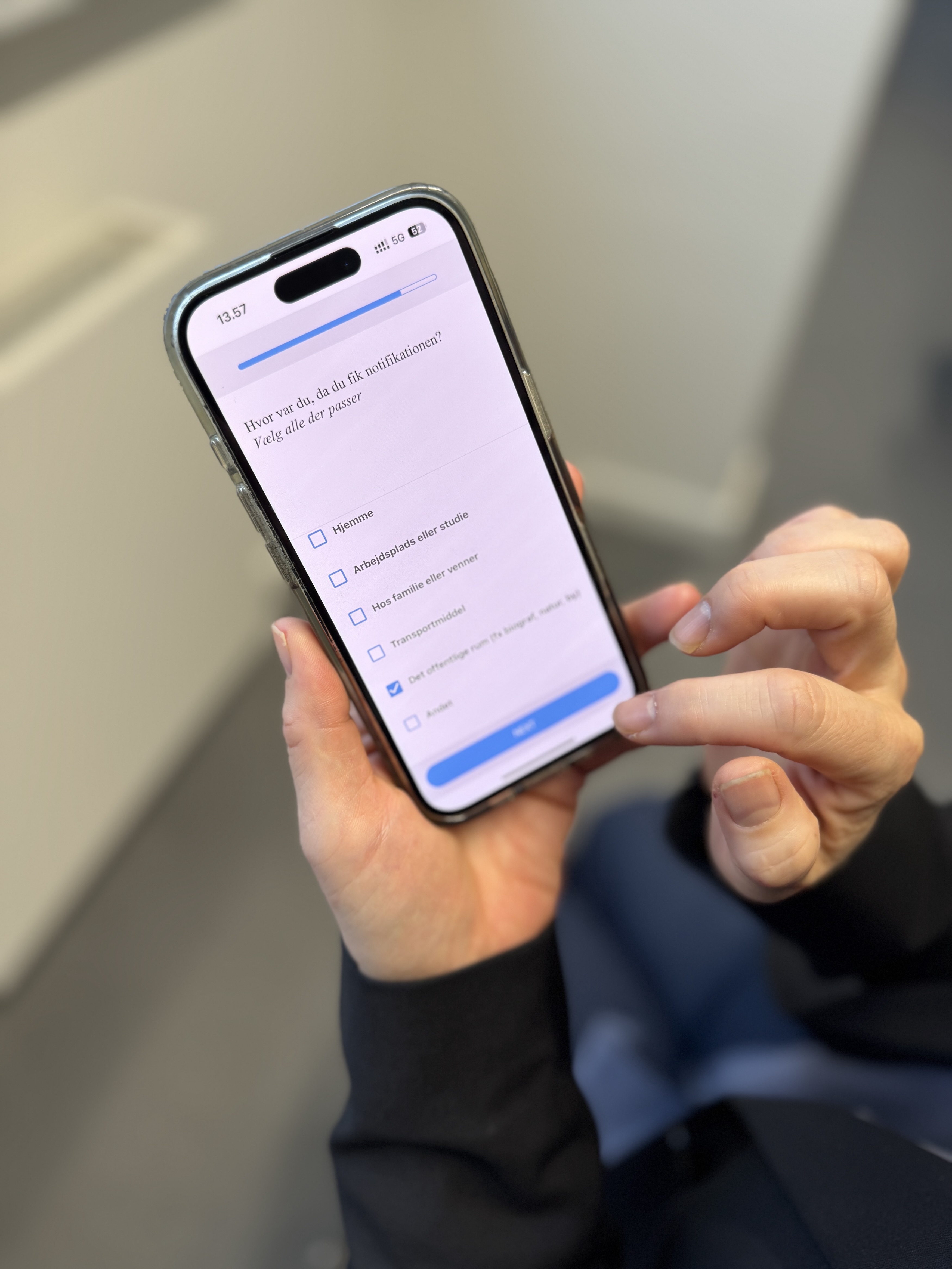
Participants answer daily questions about their fatigue in an app. PHOTO: Elsass Foundation
Fatigue in real time
Traditionally, fatigue in people with CP has been studied using questionnaires or diaries, among other methods. However, according to Christensen, both approaches have limitations.
“It can be difficult to remember how you felt last week, or what you were doing earlier in the day that led to the fatigue. That is why studying fatigue in real time provides more precise data,” she explains.
Through a research app, participants receive reminders several times a day prompting them to complete a questionnaire developed specifically for this project.
For one week, participants answer questions about their fatigue, what they are doing, where they are, and who they are with. They also wear a sensor that measures physical activity and sleep.
“We’re all tired”
According to Christensen, many people living with fatigue find it difficult to speak openly about how it affects them. Saying no to work or social activities can often lead to misunderstandings.
“When they tell family or friends that they struggle with fatigue, they are sometimes met with comments like: ‘We’re all tired’ or ‘Why don’t you just go to bed earlier?’ It can be incredibly difficult to explain that this is a completely different kind of fatigue from the one you and I experience,” she says.
What is fatigue?
The term fatigue is widely used in CP research. Among professionals in the field, it refers to a disabling, persistent exhaustion that goes beyond normal tiredness. It is often associated with an overworked nervous system, physical overexertion, pain, and poor sleep quality, and can lead to reduced energy and difficulty functioning in daily life.
Another challenge is identifying what triggers the fatigue.
“Fatigue varies depending on what you are doing, where you are, and the demands placed on you - and it can strike suddenly, even on days when you feel you have done everything right and taken all necessary precautions,” says Christensen, adding that the consequences can be significant:
“Some have to cut back significantly on social activities and leisure time, and as a result, they may lose friendships. Others are forced to stop working altogether because they simply cannot keep up - something that can have a major impact on both their finances and sense of identity.”
Data reveals hidden patterns
The app data give Christensen a clearer picture of why participants become fatigued at specific times. She uses this knowledge in feedback sessions, where she reviews the data with each participant and works with them to understand the fluctuations.
“If I notice times during the week that are far above the person’s usual fatigue level, we try to identify the cause. Participants often have small ‘aha’ moments: ‘Oh yes - that was the day I had two social events,’” she explains.
She also focuses on the times when fatigue is low. “It is just as important to understand what works - and to do more of that.”
This kind of insight is valuable for both individuals and professionals:
“Suddenly it becomes much easier to talk about fatigue. You can see the patterns clearly and ask: How can we plan around this? Where can you build in breaks? What gives you energy - and what drains you?”
Mood plays a role
The project’s preliminary data already shows some clear patterns, says Christensen. In particular, poor sleep and pain affect participants’ fatigue levels.

PhD student Sun-Hee Skovgaard Christensen expects to complete the fatigue study in 2027. PHOTO: Elsass Foundation.
“Many describe nights with restless legs, pain, and interrupted sleep - and then they wake up extremely tired,” she says, explaining that the two factors are often closely linked:
“People who experience a great deal of pain typically also report high levels of fatigue. However, we still don’t know which comes first. Others find that their mobility declines with age, and that even simple everyday tasks take a lot of energy.”
Mood can also play a role. Several participants describe worries and racing thoughts that keep them awake at night or weigh on them during the day.
“Many experience a level of mental fatigue that can lead to cognitive difficulties - they become more forgetful and have trouble concentrating,” says Christensen.
Practical strategies in everyday life
For Christensen, the feedback sessions with participants are essential, as fatigue is experienced very differently from person to person:
“Some gain energy from physical activity, while others feel the opposite. Some have young children, others demanding jobs. That’s why we always begin with the individual’s circumstances.”
During these conversations, she works with participants to find strategies that can make fatigue easier to manage.
“It is easier when you understand your own patterns. Perhaps it is about prioritising certain events or planning proper breaks before and after - in general, setting clearer boundaries for your social life,” she says.
According to the researcher, solutions can range from small adjustments to clear prioritisation. “Opting out may feel difficult in the moment, but sometimes it is an investment in long-term energy.”
The fatigue project is expected to be completed in 2027. The goal is that real-time measurements can contribute to a far more precise understanding of increased fatigue and eventually be integrated into clinical practice translated into practical recommendations.
“Fatigue is an invisible challenge for many. But data helps make it visible. And that is the first step towards enabling both individuals and the professionals that support them to implement well-informed strategies that improve quality of life,” she concludes.
Read more about CP and fatigue here.