What is it like to become a parent when your body sets limits?
For Sigrid Stilling Netteberg, it has been a life-changing experience shaped by challenges, healing and creative solutions in everyday life.
On a wet, grey day in March, Sigrid Stilling Netteberg walked into the Elsass Foundation with her seven-month-old daughter and her assistant, ready to share her experience of parenthood at a workshop shining a spotlight on the dream of having children when a mother or father has cerebral palsy (CP).
For Sigrid, motherhood began six years ago.
She vividly remembers the first weeks as a new mother to her first daughter. Hormones were raging, breastfeeding was a struggle, and in everyday life, she had to navigate both her new role as a mother and as an employer to her assistants.
Sigrid, who is 36, lives with CP herself, and this has shaped her path into motherhood. Long before she was even pregnant, many questions arose:
Can my body handle a pregnancy?
How will it affect children to have assistants around them?
What does it mean when I can’t run with them in the garden, jump on the trampoline or take them on a skiing holiday?
"What do you think you are doing?"
Several of these questions followed Sigrid into her pregnancy when she was expecting her first child.
"It was very daunting for me that my body would have to take responsibility for creating and carrying a child, when my whole life I have felt that it has let me down physically," says Sigrid.
"And I was worried that healthcare professionals would say: What do you think you are doing? That is completely irresponsible."
But that never happened. Sigrid encountered no prejudice, no looks or comments from doctors, nurses or midwives that made her doubt herself.

At the workshop on the dream of having children, Sigrid (left) shared perspectives on parenthood with CP during a panel discussion with Caroline Cecilie Nielsen (right), who also has CP and is a mother. PHOTO: Elsass Foundation
Creative solutions
It became clear to Sigrid early on that she was not going to follow the standard "parenting manual," which she describes as "incredibly narrow." In the beginning, she often pushed herself too hard and blamed CP when things did not work out.
"It is easy to blame every problem on CP, but through conversations with my friends I realised that most parents sometimes feel inadequate, and that not everything is necessarily down to my disability," says Sigrid.
And when challenges did stem from her CP, she tried to find solutions or different ways of doing things.
"I can change a nappy as long as I get some help with it, and I can feed my child as long as my assistants prepare the food," she explains, adding:
"I can’t sit on the floor and play, so we move activities up to a table. At the playground, the sand makes it hard to get around with my walker, but I can see that it means a lot to my daughter that I am there watching her on the swings or the slide, even if it is from a distance."
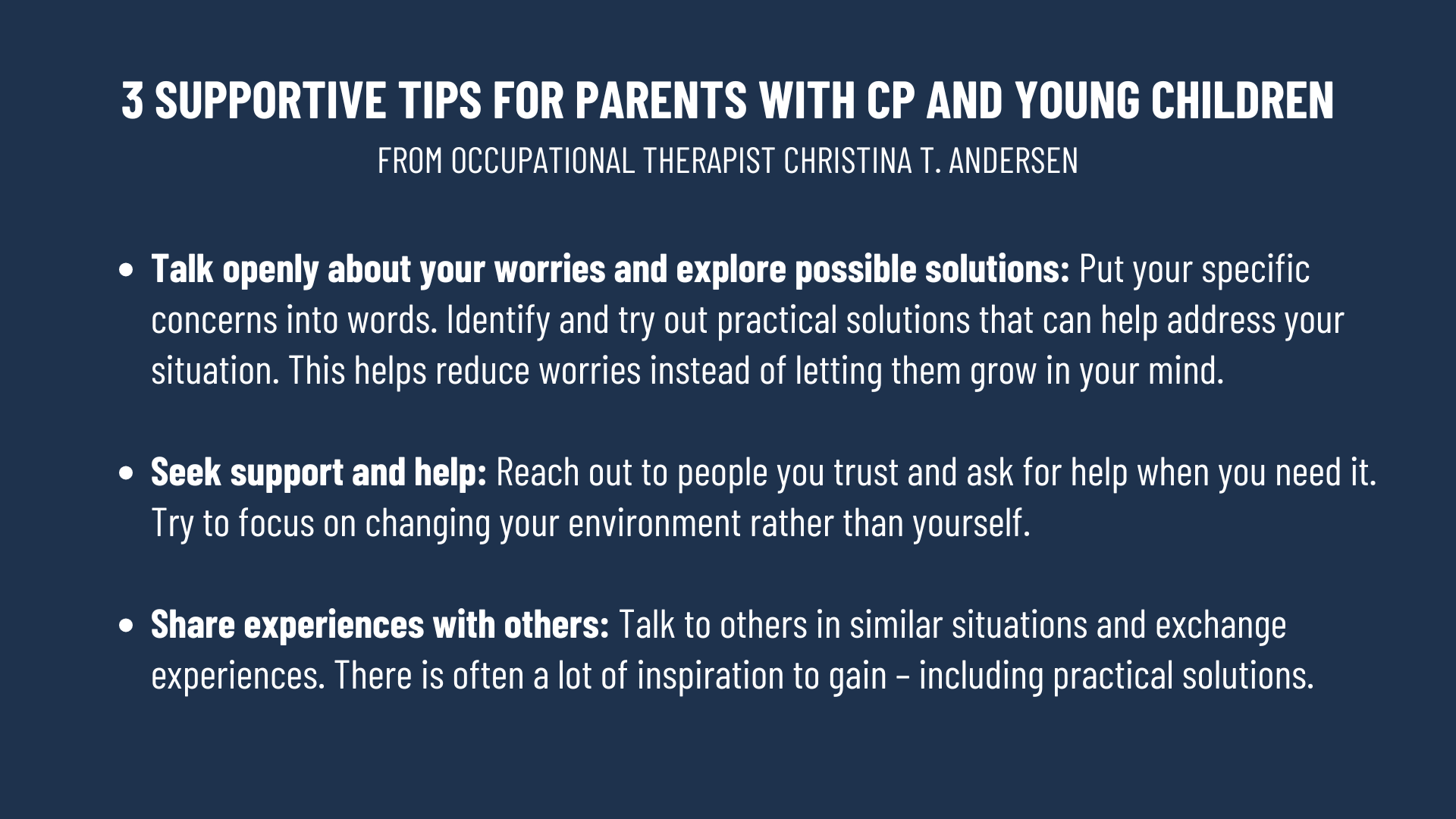
According to Christina T. Andersen, occupational therapist at the Elsass Foundation, creative solutions and ideas are the way forward.
She hears from many parents with CP, both men and women, who worry about the things they find difficult when caring for young children.
"It can be a good idea to think through which everyday activities are likely to be challenging and then look at where there is room to adjust the environment. Very often it is possible to find other ways of doing things," explains Andersen.
Mum, dad or assistant?
During a panel discussion at the same workshop, Sigrid raised one of her biggest concerns and spoke openly about her thoughts and experience on the subject.

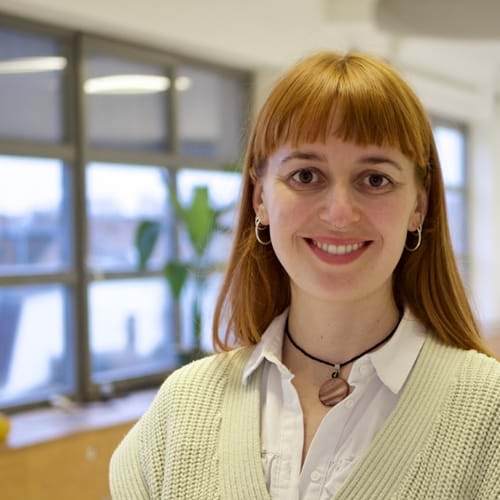
Christina T. Andersen, occupational therapist at the Elsass Foundation, has helped parents with CP develop everyday strategies. At the workshop, organised by the Elsass Foundation and CP Danmark, she shared her insights and methods. PHOTO: Elsass Foundation
"I have had assistants since I moved out on my own, so I knew that they would be part of becoming a mother for me," she says.
But how would it affect the child to be around assistants every day, and could the child become confused about who was mum and dad and who was an assistant?
These thoughts and worries were on Sigrid's mind in the early days of parenthood. She decided to make it clear which roles were hers and which belonged to her assistants.
"They’re not nannies, and they don’t look after my children. They make it possible for me to be a mother. They help with practical tasks, like preparing food, but I am the one who feeds them. I have a kind of rule that when they are with my children, I’m there too," explains Sigrid.
Her assistants are an important source of support in Sigrid's daily life, both when she faces physical challenges and when it comes to managing her energy.
"You can’t avoid getting more tired with young children. My assistants allow me to use my energy where it matters most - with my children," says Sigrid.
Double the tiredness
As Sigrid points out, life with young children is demanding. For around half of all people with CP, fatigue is already part of daily life, and it is one of the most common concerns and challenges Andersen encounters among parents with CP, both before and after the birth.
Her advice is to get to know your fatigue:
"In order to manage your energy, it is important to understand what makes you tired and what gives you energy. There are methods that can help you understand and make the most of the energy you have," she explains, adding:
"Everyone is different, and it really depends on whether it makes more sense to look at energy management before becoming a parent or once you are a bit more established in your role as a parent."
"I am no longer angry with my body"
Although parenthood, as Sigrid herself says, comes with an extra layer of challenges when you also have CP, it has also been a healing experience.
"I am proud that my body has managed to create two successful pregnancies and wonderful children. It has given me a completely new relationship with my body. I am no longer angry with it, as I have been in the past," says Sigrid, with the same thoughtful and calm strength she radiated while answering participants' questions during the panel discussion at the workshop.