
CP and starting school: From worries to understanding
As school approaches, many parents of children with CP worry about the support their child will need. The course “Getting off to a good start with learning” equips families with knowledge and tools to feel prepared for the transition.
It is Wednesday morning, and the Elsass Foundation is buzzing with the chatter of happy children and conversations among parents. Standing in a circle around occupational therapist Camilla Ejsing-Thomsen is a group of eager children. “Can any of you remember what we’re doing today?” she asks with a smile. “Raise your hand if you know the answer.” Small hands shoot into the air immediately.
For four days, the Elsass Foundation hosts “Getting off to a good start with learning” - a programme that gives families with children aged 5-7, all of whom have cerebral palsy (CP), the chance to prepare for school.
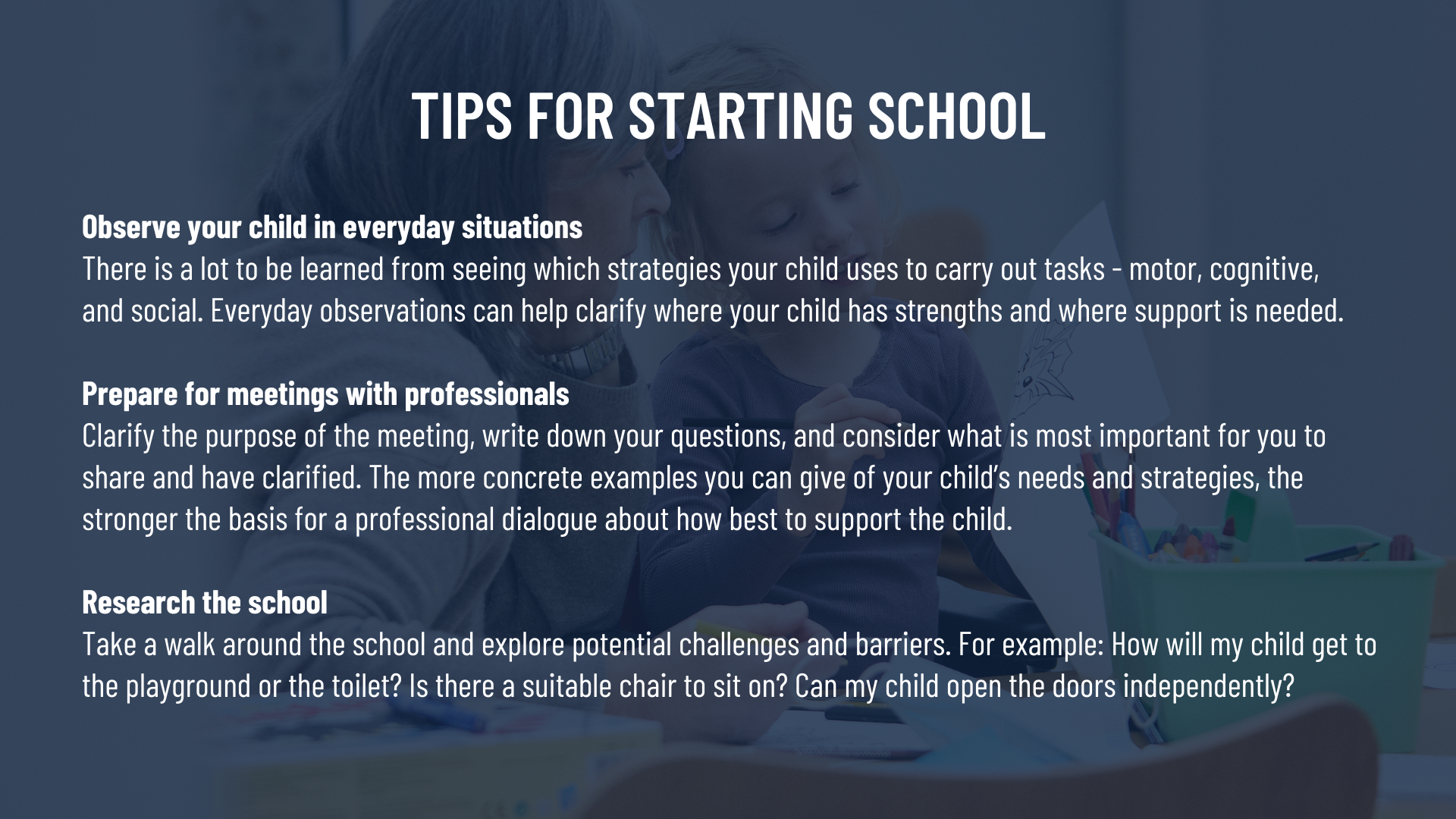
The situation reflects a typical activity in the programme, whose aim is to let parents observe their child in different social and school-related situations.
Christian Rasch is the father of six-year-old Maia, who lives with CP. They are attending the programme with Maia’s mother, Pi Bendix, and Maia’s younger sister, Clara. At home, the family has spent a great deal of time thinking about support needs and choice of school.
“We needed clarity: What does starting school actually require, and how much support will Maia need? And we also had concerns about the challenges she might face, not only physical but also cognitive, when she starts school,” Rasch explains.
Ejsing-Thomsen, who is both an occupational therapist and the course lead for “Getting off to a good start with learning” says that the transition to school can be overwhelming:
“Parents of children with CP often have a long list of worries as the start of school approaches. They may only recently have come to terms with being a family living with CP, and then all the uncertainty resurfaces, with the diagnosis once again becoming a major focus. This makes it an important moment to be met with understanding and support, to support the well-being of the whole family.”

Christian Rasch, together with his daughter Maia and the rest of the family, attended the “Getting off to a good start with learning” programme and tried out various school-related activities. PHOTO: Elsass Foundation
Parents take a step back
In the kitchen at the Elsass Foundation, the children have thrown themselves into the day’s first activity. They are preparing packed lunches for an outing, while the parents, hands clasped behind their backs, look on. The exercise is about observing and discovering how the child finds solutions independently.
According to Ejsing-Thomsen, this is a core part of the programme:
“School readiness is often assessed through tests and reports. Here, parents instead get the opportunity to see their child in practice - in situations that resemble the early years of school. Alongside our interdisciplinary team, they observe both the child’s motor and cognitive strategies and develop a shared understanding of what the child is showing them: What is particularly difficult, and where are the child’s strengths?”
She often finds that parents are surprised by their child’s strategies.
“During the lunchbox activity, for example, there was a little girl who needed to open a cheese snack. It was difficult, but she managed to open it by using her mouth, and her mother exclaimed, ‘Wow, you can do that?’” Ejsing-Thomsen recalls, continuing:
“Parents begin to notice which strategies their child uses in everyday life, and where adjustments or support might help. If a child ‘zones out’ during an activity, it may mean the child is tired or that the task is too difficult. We then ask: Could the task be solved in a different way, maybe by adding creative elements or doing it with others?”
Equipped for good collaboration
According to Ejsing-Thomsen, it is very intentional that the programme focuses on helping parents describe their child’s challenges and strengths.
“As a parent, it can be overwhelming to sit in meetings with representatives from daycare, school, and the local authority all at once. Many feel as though they are just listening to others talk about their child. That’s why we work on giving parents tools to engage in a professional dialogue about how best to support their child,” she explains, adding:
“Parents know their child best, so they bring meaningful knowledge to these conversations. For example, parents may know that their child needs visual support when receiving instructions.”
Rasch and Bendix faced this very issue when they attended a planning meeting about Maia’s school start shortly before the programme:
“I wish I had attended this programme earlier. Now I feel much better prepared for those conversations. We’ve had some of our own observations confirmed - and we’ve also become aware of areas where she is actually far more capable than we were told at the meeting,” says Rasch.
A language for CP
All the parents are seated in the Foundation’s old fireplace lounge. Small talk flows back and forth before today’s parent session begins, led by Mette Overgaard - mother of Emma, who has CP and is in ninth grade.
Through honest accounts and practical knowledge about school life, she takes the parents back to Emma’s start at school - a time marked by worries about the leap from the safety of kindergarten to the new, vast school environment, where parents naturally want to remove as many obstacles as possible for their child.
“The talk with Mette was an eye-opener. I really recognised that ‘overprotective parent’ feeling. I struggle when people point out Maia’s leg brace, and I worry that she’ll be teased at school. I’d like to spare her from that,” says Rasch.

Occupational therapist and course lead Camilla Ejsing-Thomsen develops activities for children and parents with her colleagues, based on the demands of a mainstream school setting. PHOTO: Elsass Foundation
Ejsing-Thomsen explains that the programme includes daily reflection sessions with parents, so that professionals and families are on the same page. These sessions also involve reflections on different understandings of disability and on finding a language to talk about CP - within the family, at school, and with other parents in the class.
“When a child comes home upset about something that was difficult, they need to be met in that feeling. Many parents want to compensate. If a child says, ‘It’s annoying that I fall over - the other children don’t,’ a parent might respond, ‘But you’re really great at swimming.’ Often this only makes the child more frustrated, because it truly is annoying not to be able to keep up in football,” Ejsing-Thomsen explains, continuing:
“We talk about how to stay with your child in that difficult moment - because it’s a situation many parents have worried about since the child was born.”


All children need to experience success
Behind the curtain in the large hall, excited faces are waiting. In front of the stage, parents, siblings, and grandparents are seated for the culmination of the programme: a circus performance prepared by the children together with the Elsass Foundation team.
Tightrope walkers, lion tamers, strong men, and magicians take turns on stage. Each child has chosen their own role, for this is about motivation and giving every child the opportunity to shine.
“All children need to feel that they are good at something,” says Ejsing-Thomsen, explaining that conversations with parents often focus on which environments help the child shine the most.
She observes that parents sometimes feel that attending a mainstream school is the ultimate goal, but that their perspective often shifts during the programme.
“Some realise that their child may thrive better in a specialised educational setting, where the environment is calmer and more adapted. Mainstream school is not necessarily the goal - it’s about where the child has the best conditions for learning and experiencing success,” she explains.
Applause and cheers fill the hall as the children beam with pride on stage. Four days filled with knowledge, moments of insight, and new perspectives come to an end. The Rasch family returns home with confidence in a positive start to school.
“There will be some battles to fight - and some not to fight. But I’m certain it will all work out. The programme has given us plenty of tools and the foundation for building a strong collaboration with the school, so Maia has the best possible school experience,” says Rasch, as he and his family pack the car and drive home to Hvidovre.

